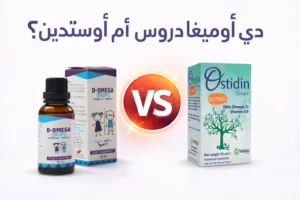

If you’re at the pharmacy choosing between D-Omega Drops and Ostidin Drops, you’re looking at two of the most popular children’s supplements in Jordan. Both combine Omega-3 and Vitamin D3 in liquid drop form and are designed for children aged 1 year and older.
But they take very different approaches — and the right choice depends on what matters most for your child’s health, and what works best in your daily routine.
At a Glance: How They Compare
| Feature | D-Omega Drops | Ostidin Drops |
| DHA (brain & vision) | ✓ Included | ✓ Included |
| EPA (mood & immunity) | ✓ Included | ✗ Not included |
| Fish oil source | Icelandic sustainable fisheries | Not specified |
| Flavor | Natural orange & lemon | No added flavor listed |
| Dropper | Advanced, contamination-resistant | Standard dropper |
| Free from allergens & additives | Non-GMO, gluten-free, dairy-free, soy-free, no artificial colors or sweeteners | Not stated |
| Servings per bottle | ~30 | ~30 |
The Complete Omega-3 Profile: DHA + EPA
This is the most important difference between the two products.
Both D-Omega Drops and Ostidin Drops contain DHA — the Omega-3 fatty acid most associated with brain development and visual acuity in children. On DHA, both products deliver.
But Omega-3 isn’t just DHA. The other essential Omega-3 fatty acid is EPA — and this is where the two products diverge.
D-Omega Drops includes both DHA and EPA. Ostidin Drops contains DHA only.
Why does EPA matter? Because it does things that DHA alone cannot:
- Mood and emotional regulation — EPA supports balanced mood in children, which affects behavior, focus, and how they handle stress at school and at home
- Inflammation management — EPA plays a key role in the body’s natural inflammatory response, supporting overall health and recovery
- Cardiovascular support — even in children, the foundations of heart health begin early, and EPA contributes to this
- Synergy with DHA — research increasingly shows that DHA and EPA work best together. They complement each other’s functions rather than overlap. A supplement with only DHA delivers an incomplete Omega-3 profile
For parents who want their child to get the full benefit of Omega-3 supplementation — not just brain support but also mood, immunity, and overall development — D-Omega’s combined DHA and EPA formulation is the more complete choice.
Omega-3 Source: Where It Comes From Matters
D-Omega Drops uses fish oil sourced from Iceland — one of the world’s most respected origins for fish oil quality. Icelandic fisheries operate under strict government oversight, with rigorous standards for sustainability and purity. The cold, clean waters of Iceland produce fish oil that is naturally rich in Omega-3 fatty acids and low in contaminants.
Vitamin D3: Guideline-Aligned Daily Dosing
Both products include Vitamin D3 (Cholecalciferol), which is essential for calcium absorption, bone health, immune function, and the prevention of conditions like rickets.
The American Academy of Pediatrics (AAP) recommends a specific daily Vitamin D3 intake for children as part of routine supplementation. D-Omega Drops is formulated to deliver exactly the AAP’s recommended daily dose — meaning parents can give it every day with confidence that their child is getting what the guidelines call for. No more, no less.
Flavor and Daily Compliance
A supplement only works if the child takes it. Every day. This is where many Omega-3 products fail — children refuse the fishy taste, and the bottle ends up unused in the cabinet.
D-Omega Drops is flavored with natural orange and lemon, specifically formulated to mask the taste of fish oil. Children who reject other fish oil supplements often accept D-Omega because the citrus flavor makes it palatable. It can also be mixed into milk, juice, or food — giving parents flexibility in how they administer it.
Ostidin Drops does not list any added flavoring. For some children, this isn’t an issue, but for picky eaters — and many young children are — an unflavored fish oil supplement can become a daily battle.
This may seem like a minor point compared to nutritional composition, but in practice, it’s one of the most common reasons parents switch products. A supplement with an excellent nutritional profile that your child won’t take is less effective than one they accept willingly every day.
For more on supplementing children who resist fish-based nutrition, read our guide on Omega-3 supplements for kids who don’t eat fish.
Safety, Quality, and Transparency
Dropper design. D-Omega Drops uses an advanced insert-in dropper designed to reduce contamination risks. Unlike standard rubber droppers, which can degrade over time and introduce contaminants, D-Omega’s dropper technology maintains hygiene throughout the bottle’s life. For a product given daily to young children, this is a practical safety consideration.
Clean-label formulation. D-Omega Drops is clearly labeled as free from GMOs, gluten, dairy, soy, artificial colors, and artificial sweeteners. For parents concerned about allergens or who want the simplest, cleanest ingredient list possible, this level of transparency matters.
What is the difference between D-Omega Drops and Ostidin Drops?
The main difference is the Omega-3 profile. D-Omega Drops contains both DHA and EPA — the two most important Omega-3 fatty acids — while Ostidin Drops contains DHA only and does not include EPA. D-Omega also features a natural citrus flavor, Icelandic-sourced fish oil, and a contamination-resistant dropper. Both products include Vitamin D3.
Does Ostidin Drops contain EPA?
No. Ostidin Drops contains DHA only. EPA (eicosapentaenoic acid) plays a distinct role in mood regulation, inflammation control, and cardiovascular support. D-Omega Drops is the only one of the two that includes both DHA and EPA.
Which supplement is better for picky eaters?
D-Omega Drops is generally better for picky eaters because it has a natural orange and lemon flavor that masks the typical fishy taste. It can also be added to milk, juice, or food. Ostidin Drops does not list any added flavoring.
Is D-Omega Drops suitable for children with allergies?
D-Omega Drops is free from gluten, dairy, soy, artificial colors, and artificial sweeteners. The Omega-3 is derived from fish oil, but the extraction process removes nearly all protein that could trigger fish allergies.